

Fidelity’s quiet but decisive entry into the world of tokenized U. S. Treasuries on Ethereum is sending ripples through institutional finance. By launching the Fidelity Digital Interest Token (FDIT) as a tokenized share class of its Treasury money market fund (FYOXX), Fidelity is not just following the crowd - it’s helping to set the pace for the next wave of digital fixed income. As of November 2025, with Ethereum trading at $3,098.12, Fidelity’s FDIT has already amassed more than $200 million in assets, signaling that institutional appetite for on-chain treasuries is maturing fast.
Why Fidelity’s Move Is a Big Deal for Institutional Blockchain Bonds
The arrival of Fidelity in this space isn’t simply another big name chasing crypto headlines. It’s a signal to other asset managers and institutional allocators that tokenized treasuries are no longer experimental - they’re becoming foundational. The tokenized U. S. Treasury market has exploded to $7.46 billion, with about 70% of those assets currently living on Ethereum. This is not just about new rails; it’s about fundamentally rethinking how liquidity, transparency, and compliance can be engineered into fixed income products from the ground up.
Unlike earlier blockchain experiments that often skirted regulatory clarity or focused on retail users, Fidelity’s approach is squarely aimed at institutions and professional investors who demand robust compliance and operational efficiency. The FDIT tokens represent real shares in an SEC-registered fund, with all transactions transparently tracked on-chain.
How On-Chain U. S. Treasuries Are Changing Fixed Income Dynamics
Tokenization isn’t just a buzzword here - it’s delivering real benefits:
- 24/7 Accessibility: No more waiting for Wall Street to open; investors can buy or redeem shares around the clock.
- Instant Settlement: Blockchain-based transactions settle in minutes instead of days, reducing counterparty risk and operational drag.
- Programmable Compliance: Smart contracts automate KYC/AML checks and whitelist management, making it easier for institutions to adhere to regulatory requirements without sacrificing speed.
- Interoperability with DeFi: FDIT tokens can be integrated into DeFi protocols for collateralization or yield strategies, bridging traditional finance and the decentralized ecosystem.
This isn’t just theoretical: we’re already seeing secondary markets emerge where tokenized treasury shares trade peer-to-peer, offering new liquidity options previously unavailable in traditional MMFs.
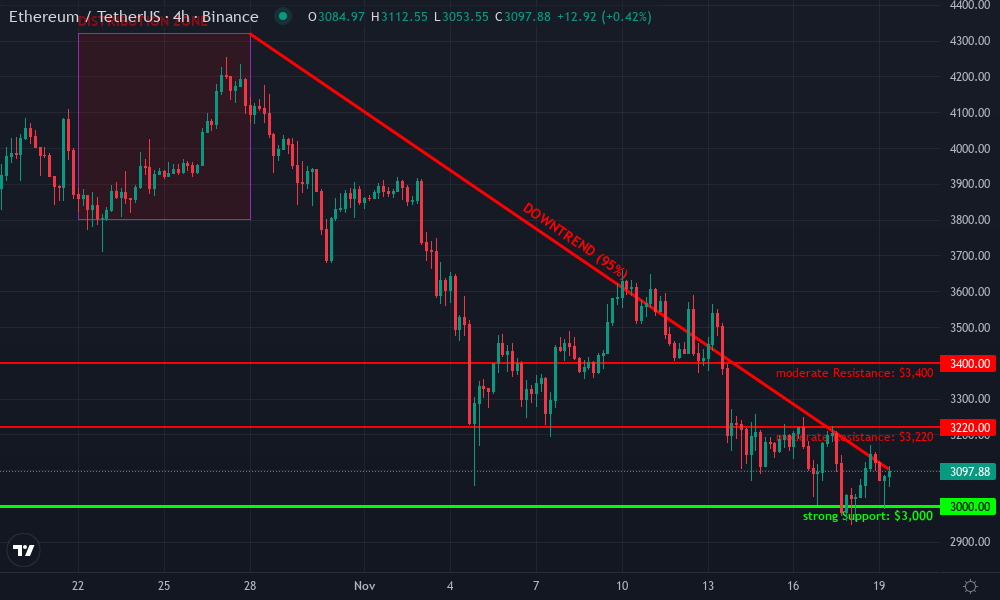
Ethereum Technical Analysis Chart
Analysis by Simon Carver | Symbol: BINANCE:ETHUSDT | Interval: 4h | Drawings: 5
Technical Analysis Summary
Start with an aggressive descending trend line from the $4,320 level on October 28, 2025, through lower highs, terminating at the current price region near $3,103 (November 19, 2025). Mark a horizontal support at $3,000, and resistance at $3,220 and $3,400. Identify a recent consolidation range between $3,000 and $3,200, and annotate a failed breakout attempt above $3,350 on November 13, 2025. Use rectangles to highlight the consolidation and distribution phases, and callouts for key breakdown events. Place a long entry marker slightly above $3,150 (if breakout confirmed), and a short entry marker below $3,000 (if breakdown confirmed). Add MACD and volume analysis callouts at local lows and highs to reinforce momentum shifts.
Risk Assessment: high
Analysis: Market is trending down aggressively with only tentative support at $3,000. Volatility is elevated, and failed breakouts indicate risk of further downside. However, institutional inflows and macro context could spark sudden reversal squeezes.
Simon Carver's Recommendation: For aggressive traders: stalk high-conviction asymmetric entries at key inflection points ($3,150 and $3,000). Use tight stops and be ready to flip bias fast. Sit out if you require trend confirmation or low volatility.
Key Support & Resistance Levels
📈 Support Levels:
- $3,000 - Major psychological and recent structural support. Multiple price reactions. strong
📉 Resistance Levels:
- $3,220 - Short-term resistance from recent failed breakout attempts. moderate
- $3,400 - Resistance from prior consolidation before recent breakdown. moderate
Trading Zones (high risk tolerance)
🎯 Entry Zones:
- $3,150 - Aggressive long trigger if price closes decisively above $3,150 resistance, targeting squeeze to $3,400. high risk
- $2,980 - Aggressive short entry on breakdown below $3,000, targeting $2,850 or lower. high risk
🚪 Exit Zones:
- $3,400 - Profit target for long breakout trade. 💰 profit target
- $2,950 - Stop loss for long if $3,000 fails. 🛡️ stop loss
- $3,100 - Profit target for short breakdown trade. 💰 profit target
- $3,050 - Stop loss for short if false breakdown below $3,000. 🛡️ stop loss
Technical Indicators Analysis
📊 Volume Analysis:
Pattern: Volume spikes correspond with sharp moves (not shown but inferred), especially on breakdowns and support bounces.
Monitor for volume confirmation on breakout above $3,150 or breakdown below $3,000—essential for trade confirmation.
📈 MACD Analysis:
Signal: Likely bearish but watch for bullish cross if price reclaims $3,150.
MACD likely showing negative momentum, but reversal possible if consolidation breaks up.
Applied TradingView Drawing Utilities
This chart analysis utilizes the following professional drawing tools:
Disclaimer: This technical analysis by Simon Carver is for educational purposes only and should not be considered as financial advice. Trading involves risk, and you should always do your own research before making investment decisions. Past performance does not guarantee future results. The analysis reflects the author's personal methodology and risk tolerance (high).
The Competitive Landscape: Who Else Is Racing Into Tokenized Treasuries?
The surge in interest isn’t limited to Fidelity alone. BlackRock, Franklin Templeton, WisdomTree, and several crypto-native players have all launched their own versions of blockchain-based treasury funds this year. But what sets Fidelity apart is its scale and brand credibility among cautious institutional allocators who may have been sitting on the sidelines until now.
If you compare inflows across these platforms since September 2025, you’ll notice that while early adopters like Ondo Finance captured initial momentum, traditional giants like Fidelity are now driving the lion’s share of growth as compliance-minded capital enters the fray.
6-Month Price Comparison: Tokenized U.S. Treasuries and Major Crypto Assets
Real-time price stability among tokenized Treasury funds and leading cryptocurrencies (2025-05-23 to 2025-11-19)
| Asset | Current Price | 6 Months Ago | Price Change |
|---|---|---|---|
| Fidelity Digital Interest Token (FDIT) | $1.00 | $1.00 | +0.0% |
| BlackRock USD Institutional Digital Liquidity Fund (BUIDL) | $0.000416 | $0.000416 | +0.0% |
| Franklin OnChain U.S. Government Money Fund (FOBXX) | $1.00 | $1.00 | +0.0% |
| Ethereum (ETH) | $3,099.05 | $3,099.05 | +0.0% |
| Bitcoin (BTC) | $91,498.00 | $91,498.00 | +0.0% |
| Tether (USDT) | $1.00 | $1.00 | +0.0% |
| USD Coin (USDC) | $0.0292 | $0.0292 | +0.0% |
| Ondo (ONDO) | $0.5359 | $0.5359 | +0.0% |
Analysis Summary
Over the past six months, tokenized U.S. Treasury funds such as Fidelity's FDIT, BlackRock's BUIDL, and Franklin's FOBXX have maintained stable prices, mirroring the price stability of major stablecoins and leading cryptocurrencies. This reflects the underlying stability of their assets and the relatively calm market conditions during this period.
Key Insights
- Tokenized Treasury funds (FDIT, BUIDL, FOBXX) have shown zero price volatility over the past six months, maintaining their pegs to underlying assets.
- Major stablecoins (USDT, USDC) have also held their pegs, demonstrating continued reliability as digital dollar equivalents.
- Leading cryptocurrencies (BTC, ETH) have exhibited minimal price movement, indicating a period of market stability.
- The consistent pricing of tokenized funds highlights their suitability for institutional investors seeking low-volatility, on-chain fixed income products.
This comparison uses exact real-time price data for each asset as provided, with 6-month historical prices and calculated percentage changes. No estimates or external data were used; all figures are sourced directly from CoinGecko and institutional reports as of 2025-11-19.
Data Sources:
- Main Asset: CoinGecko
- BlackRock USD Institutional Digital Liquidity Fund: CoinGecko
- Franklin OnChain U.S. Government Money Fund: CoinGecko
- Ethereum: CoinGecko
- Bitcoin: CoinGecko
- Tether: CoinGecko
- USD Coin: CoinGecko
- Ondo: CoinGecko
Disclaimer: Cryptocurrency prices are highly volatile and subject to market fluctuations. The data presented is for informational purposes only and should not be considered as investment advice. Always do your own research before making investment decisions.
This competitive dynamic is accelerating product innovation - expect more features like real-time auditability, automated tax reporting, and cross-chain interoperability as asset managers vie for dominance in this rapidly expanding sector.
Ethereum (ETH) Price Prediction 2026-2031
Forecasts based on institutional adoption, tokenized treasury growth, and evolving market dynamics
| Year | Minimum Price | Average Price | Maximum Price | Year-over-Year % Change (Avg) | Market Scenario Insights |
|---|---|---|---|---|---|
| 2026 | $2,700 | $3,800 | $5,200 | +22.7% | Post-ETF consolidation; steady inflows to tokenized treasuries; regulatory clarity improving |
| 2027 | $3,100 | $4,500 | $6,300 | +18.4% | Institutional adoption accelerates, more tokenized assets on-chain; increased DeFi integration |
| 2028 | $3,400 | $5,200 | $7,800 | +15.6% | Global macro volatility boosts demand for on-chain fixed income, ETH as settlement layer |
| 2029 | $3,900 | $6,000 | $9,200 | +15.4% | Ethereum upgrades (e.g., Danksharding) improve scalability; competition from other L1s |
| 2030 | $4,200 | $7,000 | $11,000 | +16.7% | Tokenized real-world assets (RWAs) surpass $25B; institutional DeFi mainstream |
| 2031 | $4,000 | $8,300 | $13,500 | +18.6% | ETH maturity as digital bond backbone, possible regulatory headwinds impact price range |
Price Prediction Summary
Ethereum is positioned to benefit substantially from the institutionalization of on-chain finance, particularly as tokenized treasuries and real-world assets grow. The average price is projected to rise from $3,800 in 2026 to $8,300 by 2031, reflecting both the maturation of the crypto market and Ethereum’s critical role as a settlement and programmability layer for institutional assets. Price volatility will remain, with bullish scenarios tied to broader adoption and integration, and bearish cases arising from regulatory or technological disruptions.
Key Factors Affecting Ethereum Price
- Growth of tokenized U.S. Treasuries and RWAs on Ethereum
- Continued institutional adoption, led by firms like Fidelity and BlackRock
- Advancements in Ethereum scalability (e.g., Danksharding, rollups)
- Evolution of DeFi and interoperability with traditional finance
- Regulatory developments in the U.S., EU, and Asia impacting crypto
- Competition from alternative L1s and L2 solutions
- Macro-economic conditions influencing demand for digital assets
Disclaimer: Cryptocurrency price predictions are speculative and based on current market analysis. Actual prices may vary significantly due to market volatility, regulatory changes, and other factors. Always do your own research before making investment decisions.
Looking ahead, the real test for Fidelity’s tokenized treasuries fund will be how seamlessly it can scale and integrate with the broader digital asset ecosystem. Institutional blockchain bonds are still in their infancy, but the infrastructure being built now is setting the stage for a new era of programmable finance, one where compliance, settlement, and liquidity are no longer bottlenecks but competitive advantages.

The implications for portfolio construction are profound. Imagine a world where on-chain U. S. treasuries can be instantly rebalanced alongside digital bonds, stablecoins, or even tokenized equities, all within a unified wallet interface. This isn’t science fiction; it’s the direction in which we’re heading as more institutions demand composability and real-time transparency from their fixed income allocations.
Navigating Compliance and Security in Tokenized Securities
Of course, this rapid evolution brings new challenges. Tokenized securities compliance remains a moving target as regulators grapple with questions around custody, transfer restrictions, and investor protections on public blockchains like Ethereum. Fidelity’s approach, anchoring FDIT to an SEC-registered fund and leveraging smart contracts for automated compliance, offers a blueprint for others to follow.
Security is another critical concern. As assets worth billions move on-chain, robust auditing of smart contracts and continuous monitoring against exploits become non-negotiable. The good news? Institutional players like Fidelity have deep experience in risk management and operational security that crypto-native issuers sometimes lack.
The bottom line: For digital bonds to truly serve institutions at scale, they must marry blockchain’s efficiency with Wall Street-grade safeguards around governance and investor rights.
Will tokenized U.S. Treasuries become the default for institutional cash management by 2027?
With Fidelity and other major asset managers launching tokenized Treasury funds on Ethereum, and over $7.46 billion in tokenized Treasuries already on-chain, do you think this trend will make tokenized Treasuries the go-to vehicle for institutional cash management within the next two years?
What Comes Next for Digital Bonds and Institutions?
The coming months will be pivotal. As Ethereum holds steady at $3,098.12, all eyes are on whether inflows into FDIT and its peers can sustain their momentum amid shifting macro conditions and evolving regulation. One thing is clear: the genie is out of the bottle, institutions have seen what’s possible when fixed income meets programmable money.
If you’re an allocator or treasury manager still watching from the sidelines, now is the time to get educated on these products’ mechanics, risks, and opportunities. Explore more about how Fidelity’s tokenized treasury initiative could shape your strategy at this in-depth guide.
This is not just a new wrapper for old assets, it’s an entirely new canvas for financial innovation. The institutions that move first will help define what digital fixed income looks like in 2025, and beyond.




No comments yet. Be the first to share your thoughts!